
A Dynasty Painted Purple
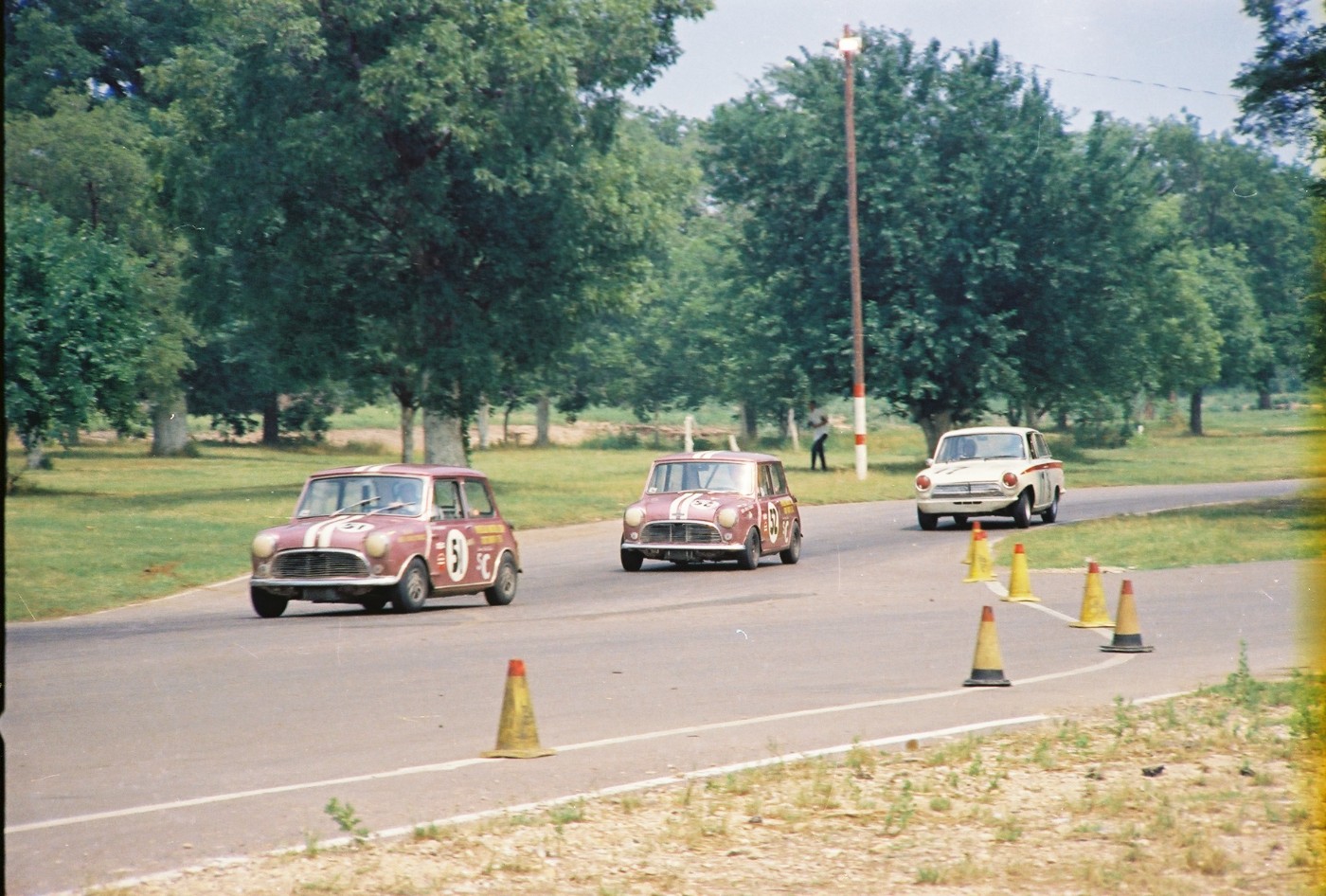
In the mid-1960s, if you were a C Sedan racer with the Sports Car Club of America and you lined up alongside a pair of gleaming maroon-and-white BMC Austin Cooper S sedans bearing the name Overseas Motors — Fort Worth, TX, you were already behind. Before the flag dropped, before the first corner, the result was almost written.
Between 1966 and 1968, Richard "Dick" McDaniel of Fort Worth, Texas won the SCCA Class C Sedan national championship three consecutive times — at Riverside in 1966, at Daytona Beach in 1967, and at Riverside again in 1968. In doing so he earned the SCCA's most coveted individual honor, the President's Cup, awarded for "ability, competitiveness, and success during the year." No other driver in C Sedan history had matched that run.
But McDaniel was the first to say the purple cars were never a one-man show. Sharing every mile of glory — blocking rivals, protecting leads, and absorbing punishment so his teammate could win — was Hugh Gammer in the sister #51 car. Together they formed one of the most formidable privateer racing teams the SCCA had ever seen.
The Man Behind the Wheel
Richard McDaniel was not a professional racing driver in the conventional sense. By trade he was a business executive — general manager of Overseas Motors Corporation, the BMC, Jaguar, and Rolls-Royce dealer on the west side of Fort Worth. Racing was, as he put it, only his avocation. But it was an avocation prosecuted with championship-level intensity.
A native Fort Worthian, McDaniel's first brush with a race car came in 1946 at the Jacksboro Speedway — a jalopy race that he won, despite, in his own words, being "so scared I couldn't see straight."
"I probably won because I was lucky enough to get off in the lead, and I was afraid to have anyone pass me." — Richard McDaniel, reflecting on his first race, Jacksboro Speedway, 1946
Over the next two decades McDaniel raced in a remarkable breadth of machinery — hardtops, modifieds, modified stocks, stocks, sprints, midgets, late model stocks, formula cars, production models, and sports cars — and claimed a debut victory in every single class he entered. That record across 12 different types of racers over 21 years stands as perhaps unmatched in American club racing history.
It was not a painless career. In 1959, a high-speed crash at Anderson, Indiana left him with a broken neck, a rib-punctured lung, and severe internal injuries. Characteristically, he returned to the track with his ribs still taped and his neck encased in a steel brace — and won three more races before fully recovering. By 1951, at his father's urging, he had stepped back from full-time racing, taking a "real job" and limiting himself to amateur competition. It was in that amateur world, behind the wheel of a tiny British sedan, that he would forge his greatest legacy.
The Cars: "Purple People Eaters"
The weapon of choice was the 1965 Austin Cooper 1275 "S" — a diminutive, front-wheel-drive British saloon displacing just 1,275cc, producing approximately 120 horsepower, and tipping the scales at a featherweight 1,400 lbs. In stock form it was a quick little car. Prepared to SCCA C Sedan specification by the Overseas Motors shop, it was a terror.
McDaniel campaigned two cars in the purple-and-white livery of Overseas Motors: his own #61 (later renumbered #61) and the sister car driven by teammate Hugh Gammer. The cars were identical in preparation, equally dangerous on track, and inseparable in legend. Fans and competitors came to call them the "Purple People Eaters" — a nickname that stuck.
One of the cars carries a distinctive detail that tells its own story: a small tree painted on the driver's door. The emblem commemorates a race in which McDaniel was run off the circuit and made contact with a roadside tree — after which the tree was added as a badge of honor, a reminder that even the best drivers sometimes meet the scenery.
The Machine: 1965 Austin Cooper 1275 "S"
- Engine: 1,275cc BMC A-Series inline-four, ~120 hp (race-prepared)
- Weight: ~1,400 lbs race-ready
- Drive: Front-wheel drive; 4-speed close-ratio gearbox
- SCCA class: C Sedan (CS)
- Livery: Purple with white racing stripes; Overseas Motors lettering
- Nickname: "Purple People Eater"
- Top speed at Daytona (1967): Over 130 mph on the straight
Championship One: Riverside, 1966
The 1966 American Road Race of Champions (ARRC) was held at Riverside International Raceway in California — then the most prestigious road course in the American west. McDaniel arrived as a regional champion but still something of an unknown quantity on the national stage. He left as C Sedan national champion.
The victory was not merely a talent showcase; it was proof of concept for the two-car Overseas Motors strategy. Gammer's #51 ran point interference, protecting McDaniel's #61 from pressure and forcing rivals to fight on two fronts simultaneously. It was a team-racing philosophy borrowed from the great factory efforts — Cooper, Lotus, Ford — applied here by a Texas dealer team operating on amateur budgets.
The 1966 season also produced one of the most storied moments in the team's history. On February 12–13, 1966, at the "South Polar Prix" SCCA Regional race at Green Valley Raceway in Smithfield, Texas, Mexican Formula One star Pedro Rodriguez took a trial run in one of the Overseas Motors Mini-Coopers — a moment captured in the regional SCCA press and in Sports Car Graphic magazine.
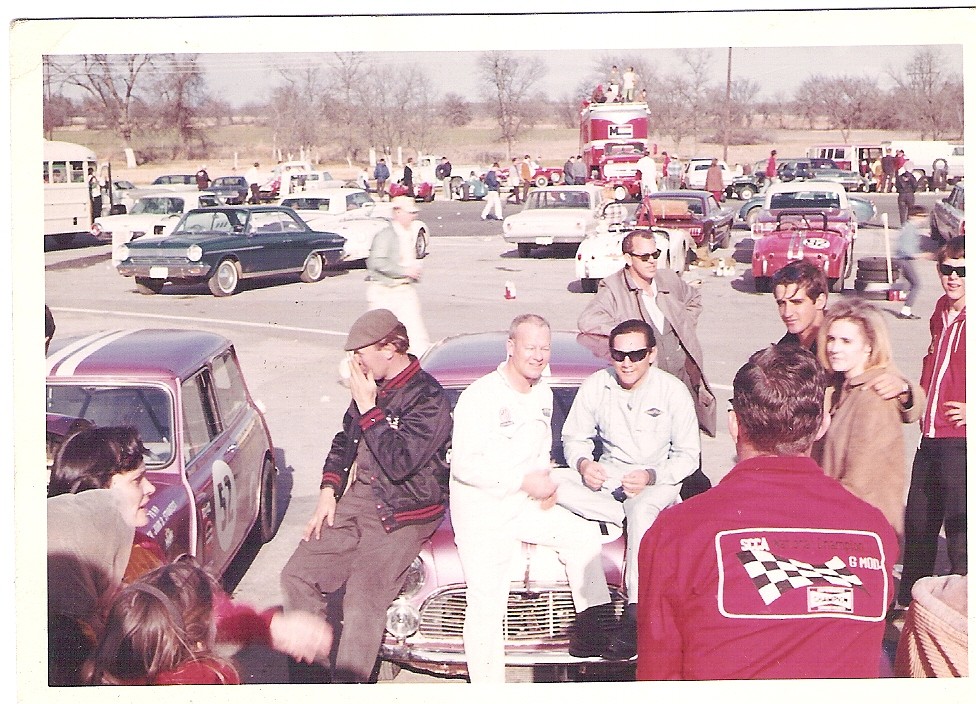
ⓘ Save the paddock photo as Paddock_Scene.jpg in the same folder as this HTML file to display the image above.
Championship Two: Daytona Beach, 1967
The 1967 ARRC moved to Daytona International Speedway in Florida, a circuit that combined the famous high-speed banking with an infield road course — a unique test that rewarded both outright horsepower and handling finesse. For a 1,400-lb Mini-Cooper capable of exceeding 130 mph on Daytona's long straight, it was a near-ideal circuit.
McDaniel ran away from a field of 20 of the country's top C Sedan drivers, including six divisional champions who had earned their way to the national runoffs. He won the 35-lap race at an average speed of 71.388 mph — a seemingly modest number that belies the pace, given the tight infield sections and the constant traffic management required over more than an hour of hard racing.
Back-to-back SCCA national championships. Two in a row. Only a handful of drivers in any class had done it before. McDaniel was 39 years old.
RICHARD McDANIEL … Two in a row
"The car in which he has won national championships back to back is a BMC Austin Cooper 'S' sedan, a tiny 120 horse-power British-made vehicle weighing only 1,400 lbs."
— Fort Worth Star-Telegram sports desk, following the 1967 ARRC
Championship Three: Riverside, 1968 — and the President's Cup
The third title — the one that made history — came back where it all started: Riverside, California, 1968. And this time Hugh Gammer did not merely play a supporting role. He crossed the line in second place, giving Overseas Motors a 1-2 finish at the national championship. McDaniel first, Gammer second. A Fort Worth 1-2 on the grandest stage in American club racing.
The race itself was brutal. A competitor collided with McDaniel's #61 twice and passed him four times during the event. That same car hit Gammer's #51 sixteen times. Yet both purple Minis were still running — and running in the top two positions — at the checkered flag. That durability, that refusal to break, spoke equally to the preparation of the shop and the composure of both drivers.
"Not only that — he hit Hugh's car 16 times. But that's how competitive that race is. People work all year for it and when they get to Riverside it's either win it or watch it." — Richard McDaniel, after the 1968 ARRC, Riverside
In recognition of his unprecedented three-peat, the SCCA presented McDaniel with its highest individual honor: the President's Cup, awarded for "ability, competitiveness, and success during the year." Running out of meaningful accolades, the organization had handed him the biggest one it had. McDaniel, characteristically, deflected the credit.
"A driver doesn't win something like that alone. You have to have someone willing to spend the money and a mechanic to do the work." — Richard McDaniel, on accepting the SCCA President's Cup, 1968
Hugh Gammer: The Indispensable #51
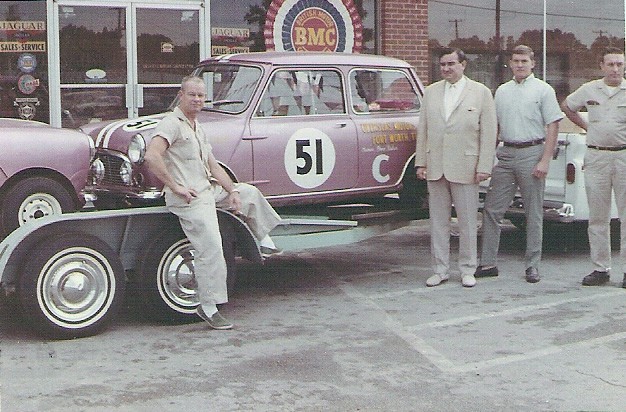
Behind every championship season was a story that the results sheet alone cannot tell — and that story belongs to Hugh Gammer. In a sport where teammates can become rivals, Gammer drove the #51 car with singular purpose: to help the team win, even when that meant sacrificing his own race.
A two-car operation at the national level demands an extraordinary degree of trust and unselfishness. The teammate must be fast enough to pressure rivals and hold off challengers, but disciplined enough to let the team's lead driver through when strategy demands it. Gammer filled that role across three championship seasons without complaint — and then, at Riverside in 1968, he delivered the most complete performance of his career, finishing second to give Overseas Motors a national 1-2.
Without Gammer in the sister car, rivals could focus entirely on McDaniel. With Gammer present, they faced two threats, two racing lines, two sets of tactics. The arithmetic of that advantage, compounded over 35-lap championship races, was decisive. Three titles in three years made it undeniable.
When McDaniel decided to move on after the 1968 season — pondering Trans-American Firebirds and Formula A — both purple cars were sold. Gammer's #51 went first. McDaniel's #61 followed. Four years together. Three championships. One unforgettable legacy.
A Witness From the Grandstand
The impact of the Overseas Motors team extended beyond the results. Writing to subsequent car owner Robert Hoemke in January 2004, Fort Worth-area motorsport fan Don Gwynne recalled watching the purple Minis as a young man at Green Valley Raceway in the 1965–66 period:
"I enjoyed watching Hugh Gammer and Rich McDaniel drive the two purple Overseas Motors C Sedan Mini-Coopers back in the 1965–1966 timeframe at Green Valley Raceway, Smithfield, Texas… As you know by now, your car is rather famous. You are very fortunate to own such a piece of SCCA racing history." — Don Gwynne, letter to Robert Hoemke, January 13, 2004
Gwynne also noted that he had personally witnessed Formula One driver Pedro Rodriguez's trial run in one of the Overseas cars — an event that drew regional press coverage and spoke to the caliber of machine McDaniel and Gammer were campaigning.
Notable Wins & Milestones Summary
| Year | Event / Race | Venue | Result | Notes |
|---|---|---|---|---|
| 1946 | Jalopy Race | Jacksboro Speedway, Fort Worth, TX | 🏆 1st — Debut Victory | First ever race entry; won despite being, in his words, "so scared I couldn't see straight" |
| 1959 | Crash recovery races | Anderson, IN area | 3 wins while wearing neck brace | Won 3 races with broken neck and taped ribs following severe crash at Anderson, Indiana |
| Feb 1966 | "South Polar Prix" SCCA Regional | Green Valley Raceway, Smithfield, TX | F1 driver Pedro Rodriguez tests #51 | Rodriguez took a trial run in the Overseas Motors Mini-Cooper S; covered by Sports Car Graphic |
| 1966 | SCCA C Sedan National Championship (ARRC) | Riverside International Raceway, CA | 🏆 National Champion — 1st Title | McDaniel's first SCCA national crown; Gammer ran the sister #51 in support |
| 1967 | SCCA C Sedan National Championship (ARRC) | Daytona International Speedway, FL | 🏆 National Champion — 2nd Title | 35-lap race; avg. 71.388 mph; top speed 130+ mph on Daytona straights; defeated 20 drivers incl. 6 divisional champs |
| 1968 | SCCA C Sedan National Championship (ARRC) | Riverside International Raceway, CA | 🏆 National Champion — 3rd Title & SCCA President's Cup | McDaniel 1st, Gammer 2nd — Overseas Motors 1-2 finish; third car collided with McDaniel twice and with Gammer 16 times |
What Came Next
After 1968, having accomplished everything there was to accomplish in C Sedan, McDaniel set his sights on bigger challenges. "We want to go big-time," he told the Fort Worth Star-Telegram after the Riverside victory. Plans were discussed for a Trans-American Sedan circuit campaign in a Pontiac Firebird, and possibly a Formula A car aimed at U.S. Grand Prix races. Even in stepping back, the Overseas Motors team promised to field something at Green Valley's national events in 1969 to stay in qualifying contention.
McDaniel sold Gammer's #51 almost immediately after the 1968 ARRC. His own #61 followed. "This was four years for 'em," he explained. "I just figure when you win the President's Cup it's time to really do something — especially when you're my age." He was 40 years old.
The #61 car survived. After seventeen years in storage, Robert Merrill purchased and fully restored it to its 1967 ARRC-winning specification — complete with the famous tree on the driver's door. The car eventually passed to Robert Hoemke, who kept it in active vintage competition. The Purple People Eater races on.
Legacy
In the larger sweep of American motorsport, Dick McDaniel and Hugh Gammer occupy a unique space: a small-town dealer team, funded on a businessman's hobby budget, that mastered the national stage through preparation, strategy, and the rare kind of trust that makes two cars race as one. Three SCCA C Sedan national titles. A President's Cup. A 1-2 at Riverside. A Formula One driver who wanted to know what the fuss was about.
Not bad for a pair of 1,400-lb British sedans painted purple.
"In the sixties no other Mini approached the record of the 'Purple People Eater'." — From the car's restoration history, circa 2011